


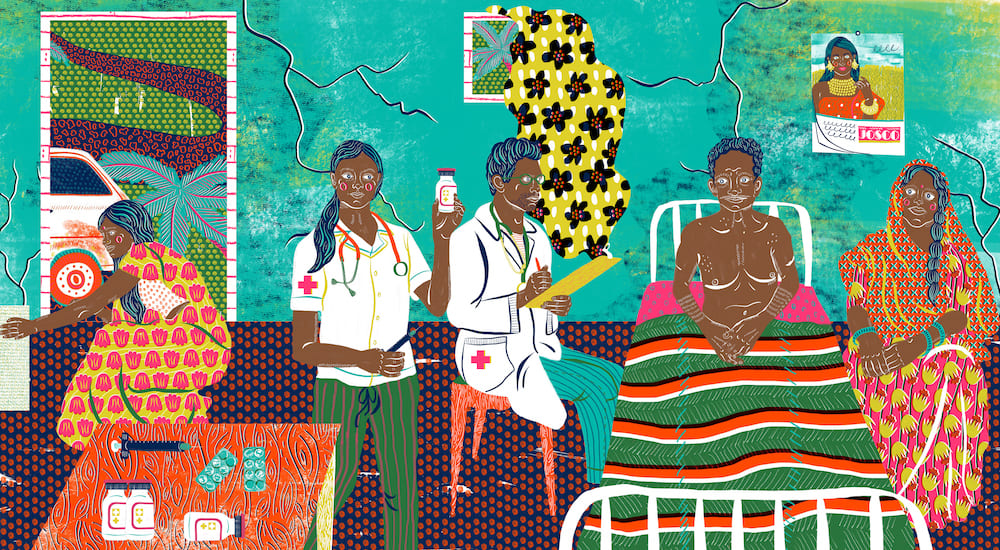
Image: Delivering palliative care in Kerala, India ©Camilla Perkins, camillaperkins.com
Delivering palliative care to avoid unnecessary health-related suffering is defined by the World Health Organization (WHO) as “a moral imperative and a human right”. Yet only a tiny proportion of the estimated 57 million people who need palliative care each year are able to get the care they need.
To assist countries in their efforts to introduce effective palliative care services, the WHO recently published new guidance. New WHO technical tools and a forthcoming ‘compendium’ of resources will address widely varying international needs and circumstances, assisting resource-poor countries to integrate palliative care into universal health coverage.
Recognising that different models are needed for different countries, the WHO is effectively offering a menu of indicators to monitor success in palliative care provision, leaving countries free to adopt what is most suitable for their particular setting. The hope is that governments will be more likely to invest in palliative care because it is more practicable.
“We need to ensure universal access to palliative care, but this is far from the reality,” said Marie-Charlotte Bouësseau, Ethics and Health team leader at WHO headquarters in Geneva. “We know that the great majority of populations around the globe do not have access to palliative care.” Worldwide only about 12 per cent of palliative care need is currently being met.
Emmanuel Luyirika, Executive Director of the African Palliative Care Association, said the new tools could be used to call on African governments to act. “The documents clearly define the actions that governments can use to improve and measure access and delivery of palliative care…Governments do not have to re-invent the wheel. They can adapt and adopt them for better service delivery.”
“Once you are able to measure, you can hold people accountable and improve on service delivery,” said Luyirika. “But the actions also require governments to invest in their health systems.”
World Health Assembly resolutions recognise palliative care as an ethical responsibility of health systems and call for WHO Member States to assure its delivery through comprehensive primary health care services. This mandate is related to the commitment to universal health coverage.
“Governments do not have to re-invent the wheel. They can adapt and adopt them for better service delivery”
The documents released by WHO include a set of actionable indicators that can be used by countries to monitor and assess the development of palliative care and resources on practical approaches to supporting policy, strategy and practice. Countries can select from a set of indicators for monitoring national strategies, policies and plans. These can be incorporated into planning and delivery at the national, district and point-of-care levels.
The WHO documents stress that providing good palliative care is an ethical responsibility for the whole community – not only for health professionals but also the social workers, family caregivers and community caregivers.
“There is very little value in creating access to services that are ineffective, unsafe, are inefficient and not timely enough to provide the care that people need,” said Anna Ray a palliative care expert from the WHO Integrated Health Services Department.
“The model would not be ‘copy and paste’ because building palliative care is like building a house: we should not build the house the same way in Uganda, Japan or Costa Rica. So I think this adaptation is crucial at local level, to maximize the impact and the quality of what we do,” said Ray.
She said that the indicators were the product of a consensus building exercise involving experts from around the world. But their benefits needed to be verified in the real world.
“The important issue here is quality. It takes concerted effort across the health system from all of our different perspectives”
Uganda is one of the countries that has been selected to use these new indicators to see how they work in practice. Mark Mwesigwa, the country director of the Palliative Care Association of Uganda (PCAU), said: “When you look at the new model, it empowers people in the community who know that the service is available and they can seek the services. The issue for us now is how best we can actually develop our own indicators based on the framework that has been laid down.”
“I think the important issue here is quality. It doesn’t happen by accident. It takes concerted effort across the health system from all of our different perspectives,” he said.